

If you are recording at home, building a small studio, connecting guitar pedals, wiring up outboard gear or trying to stop a mystery hum, audio cables can get confusing quickly.
People often say things like “jack cable”, “balanced cable”, “stereo cable” or “instrument cable” as if they all mean the same thing. They do not. Using the wrong cable does not always stop things working, but it can cause noise, weak signal, phase issues, level problems or equipment behaving in a way that feels random.
This guide explains the main cable types you are likely to come across in a recording or mixing setup, including TS, TRS, XLR, RCA, speaker cables, MIDI and digital cables.
If you only remember one thing, remember this, a cable’s connector type does not always tell you what the signal type is.
For example, a 1/4-inch jack cable could be:
A TS instrument cable for guitar
A TRS balanced line cable for studio gear
A TRS stereo headphone cable
A speaker cable for an amp and cabinet
They may look similar, but they are not always interchangeable.
TS Cable

This is a 1/4" jack from a guitar cable, but you also see smaller 3.5mm plugs as well.
TS stands for Tip-Sleeve, the tip carries the signal and the sleeve is the ground/shield.
The easiest way to recognise one of thes is by the single black ring on the plug.
Commonly used as instrument cables for:
Electric guitars and basses
Synth outputs
TS cables carry an unbalanced mono signal so are more vulnerable to noise over longer cable runs, especially around power supplies, lighting and computers.
TRS Cable
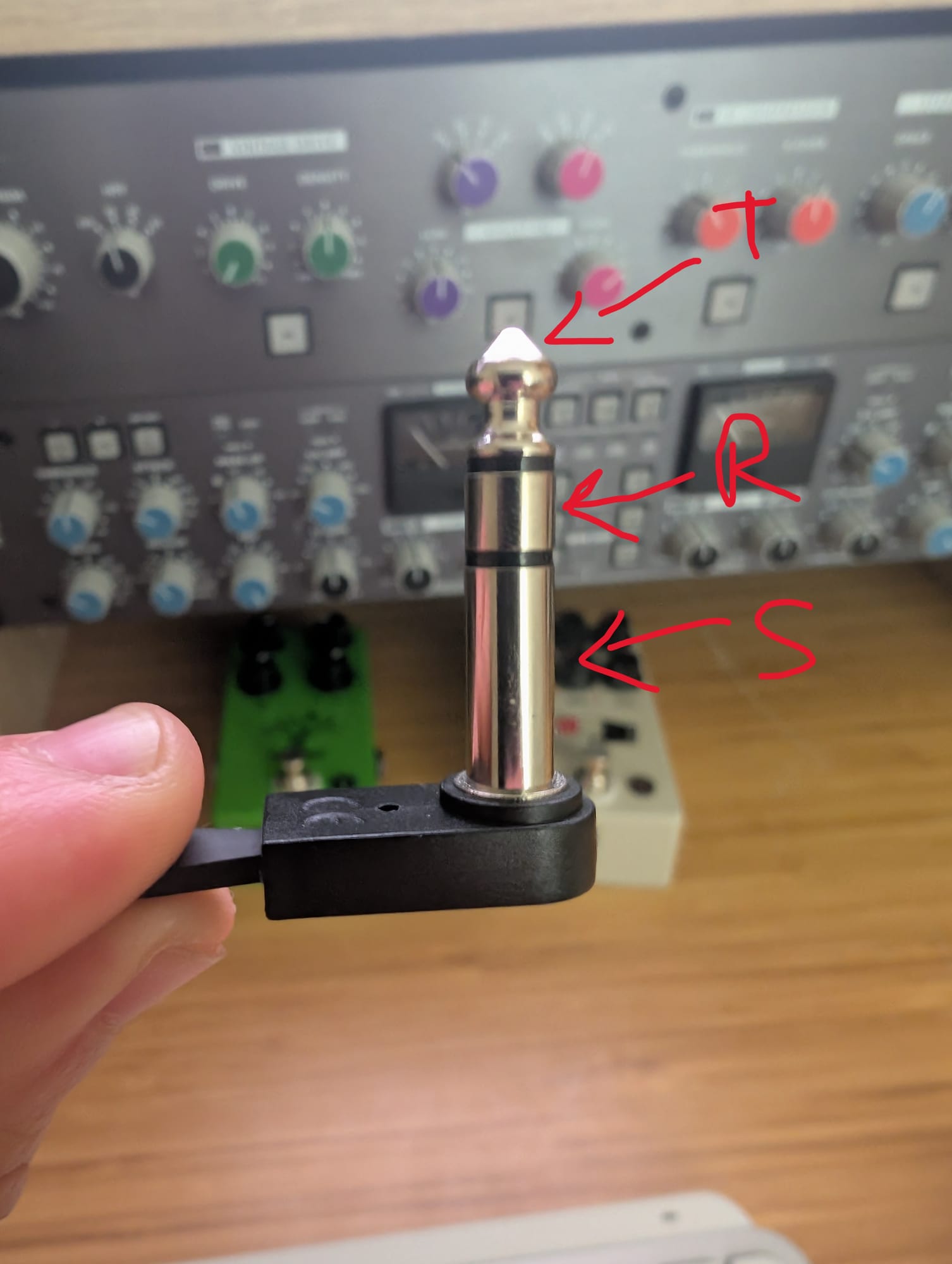
1/4" jack from a patch cable shown here, also come in smaller 3.5mm size as well (typically on headphone cables)
TRS stands for Tip-Ring-Sleeve and has three contact points.
Easily recognisable by the two black rings on the plug.
TRS cables can be used for both stereo and mono, and in a studio context it's often used to carry a balanced mono signal.
TRS cables can also be used to carry unbalanced stereo signals, such as the cable on a pair of heaphones.
Balanced vs Unbalanced Audio
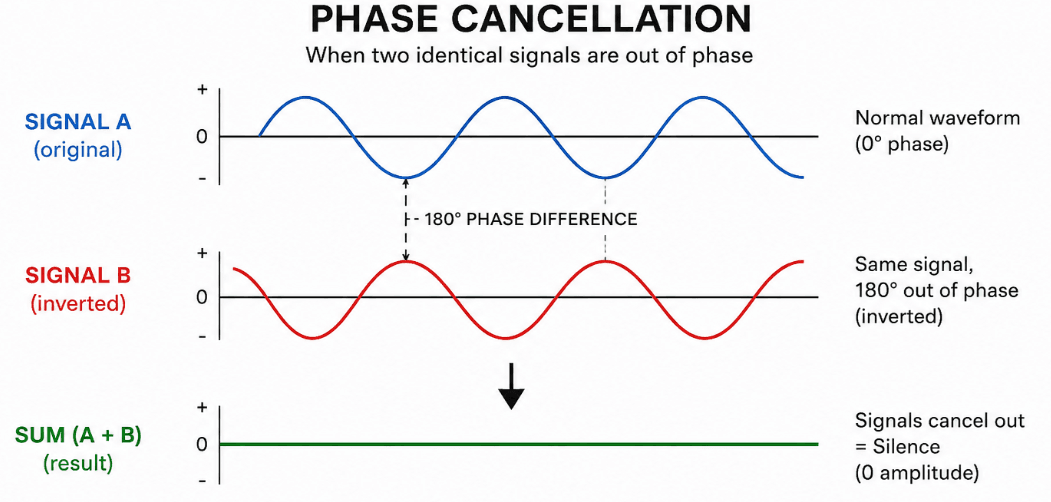
So what does "balanced" mean? A balanced mono cable is designed to reduce noise by having two copies of the mono signal, but one is phase flipped.
Both signals then pick up the same noise along the cable run and when the signal is phase flipped again at the other end, any noise that was picked up is phase cancelled out:
XLR Cables
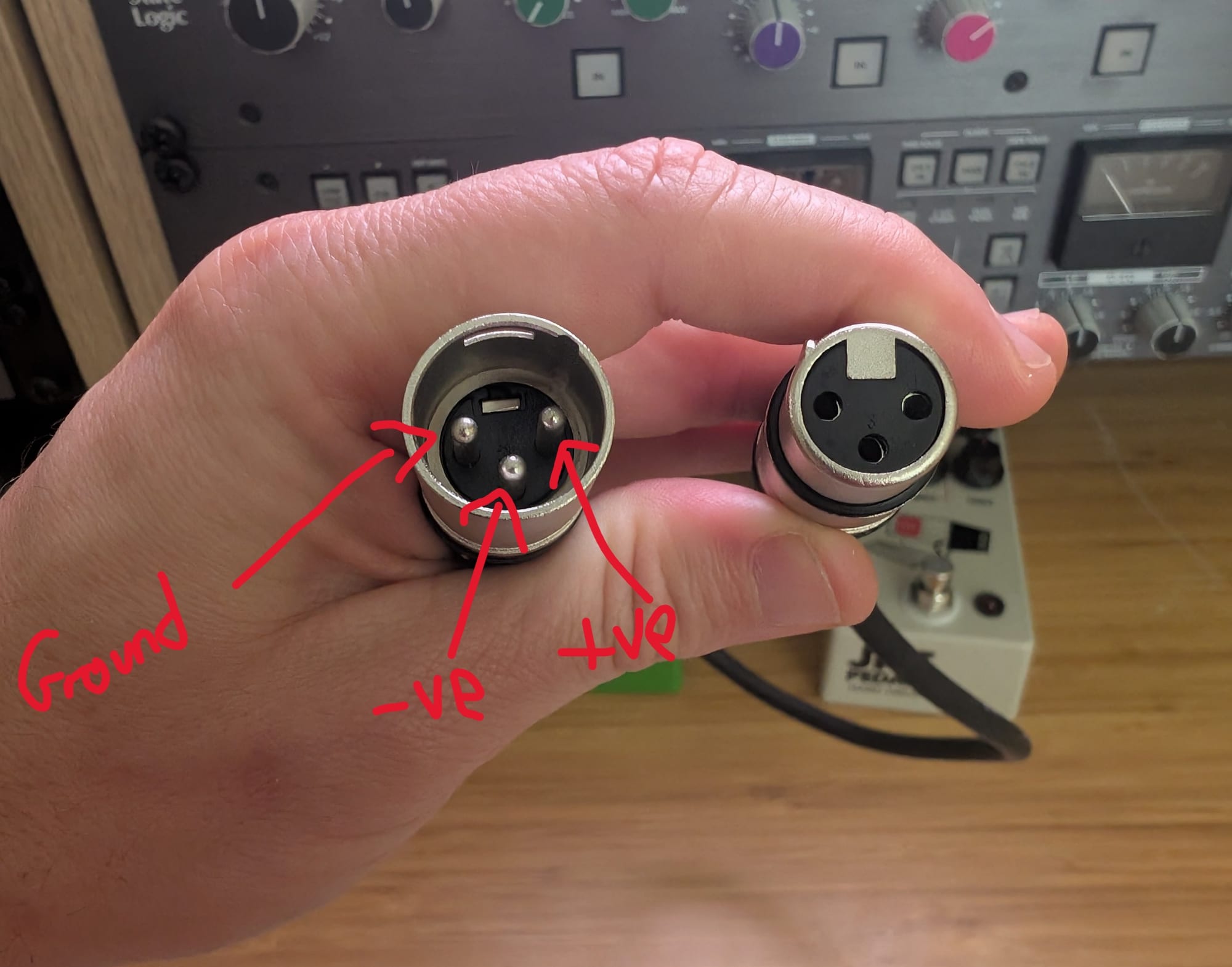
Standrad XLR cables have three pins (they are technically called XLR-3 for this reason) and usually carry a balanced mono signal.
Standard XLR cables are female to male with different connectors at each end of the cable. The end with the pins in the male which outputs signal, and the connector with the holes is the female one which receives the signal.
You can get variants with extra pins, like the XLR-5 but the XLR-3 is your classic microphone cable and it's often used for other studio gear as well.
Common Mistakes
Don't assume a TRS cable is stereo, it's often mono, the connector alone doesn't tell the whole story
Don't assume a TRS cable is balanced, if it's a stereo cable, it will be unbalanced
Try to avoid running long unbalanced cables as they will pick up noise and hum
A jack to XLR adapter does not magically change the signal from an unbalanced to a balanced one, it will connect the gear but the noise may remain
Some pedals / synths and other gear may have stereo ouputs which need a TRS connector to function properly, check the manual!